Table of Contents
ToggleParisian interior design doesn’t try too hard. It layers antique finds with modern art, pairs herringbone floors with minimalist linen sofas, and never looks like it was assembled from a single showroom trip. This style has spent centuries perfecting an effortless balance between old-world craftsmanship and livable, unfussy elegance. The good news? Achieving an authentic Parisian look doesn’t require tearing down walls or importing marble from Burgundy. With the right architectural details, restrained color choices, and carefully edited furnishings, any homeowner can bring this timeless aesthetic into their space, no passport required.
Key Takeaways
- Parisian interior design prioritizes restraint and craftsmanship by mixing eras and high-quality pieces rather than filling spaces with trend-driven purchases.
- Architectural details like crown molding, ceiling medallions, and herringbone floors define the authentic style, with polyurethane molding offering budget-friendly alternatives for standard homes.
- Neutral color palettes featuring warm whites, soft grays, and greige create the foundation, while accent colors and brass metals add sophistication without overwhelming the space.
- Furniture should have exposed wood legs, natural materials like linen and leather, and a lived-in character, making vintage finds and secondhand pieces ideal for achieving Parisian elegance.
- Layered lighting with dimmers, large mirrors, simple textile arrangements, and ruthlessly edited art and accessories complete the effortlessly curated Parisian aesthetic.
- Achieving Parisian interior design doesn’t require expensive renovations—intentional choices in architectural details, color schemes, and furniture curation create the timeless look on any budget.
What Defines Parisian Interior Design?
Parisian interior design evolved in Haussmannian apartments built during the mid-1800s renovation of Paris. These spaces featured tall ceilings (often 10–12 feet), large windows, intricate plasterwork, and chevron or herringbone oak floors. The style prioritizes architectural bones over decoration.
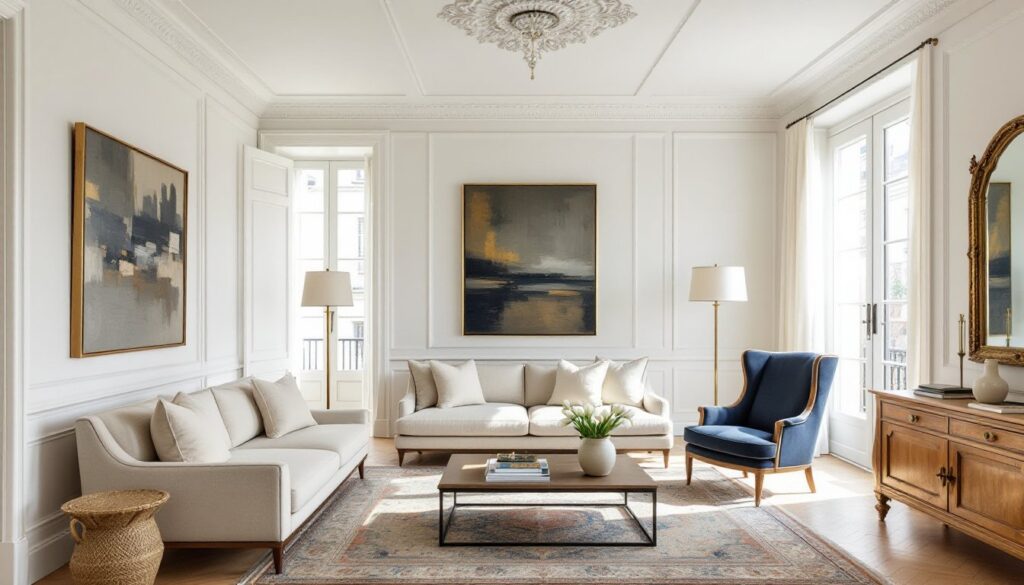
Unlike maximalist approaches that fill every corner, Parisian interiors embrace restraint. Rooms feel curated rather than staged, with fewer pieces chosen for quality and character. A single vintage chandelier does more work than a cluster of trendy pendants. Paint stays neutral, soft whites, warm grays, greige, but textures vary through linen, velvet, aged wood, and brass.
Functionality matters. Parisian apartments are rarely sprawling, so furniture serves multiple purposes. A console table behind a sofa adds surface space without blocking flow. Open shelving in kitchens displays everyday dishes like décor. Storage hides behind paneled doors or vintage armoires.
Authenticity comes from mixing eras. A Louis XVI chair might sit beside a midcentury lamp and a contemporary painting. The common thread isn’t period accuracy, it’s a commitment to craftsmanship, natural materials, and pieces with visible history.
Key Elements of Authentic Parisian Style
Architectural Details and Moldings
Parisian interiors rely on crown molding, baseboards, panel molding, and ceiling medallions to add dimension without color or pattern. Original Haussmannian apartments featured ornate plaster moldings up to 8–12 inches tall. Reproducing this look is possible even in standard 8-foot-ceiling homes, though proportions need adjustment.
For DIYers, polyurethane molding offers a budget-friendly alternative to plaster or wood. Products like Ekena Millwork or Metrie panels come pre-primed and install with adhesive and finish nails. A typical panel molding layout uses 3–4-inch-wide trim arranged in rectangular frames on walls, spaced evenly to create symmetry. Measure and dry-fit before nailing: mistakes show clearly on plain walls.
Ceiling medallions should scale to the room. An 18–24-inch medallion suits a dining room with a chandelier, while anything over 30 inches looks overwrought unless ceilings are 10+ feet. Install medallions around existing junction boxes using construction adhesive and finishing screws into ceiling joists (locate with a stud finder first). Paint medallions the same color as the ceiling for subtlety, Parisians rarely highlight moldings in contrast colors.
Herringbone or chevron wood floors define Parisian spaces, but they’re labor-intensive. Expect to pay $12–$20 per square foot installed for solid oak herringbone, versus $4–$8 for standard plank flooring. For a DIY approach, luxury vinyl plank (LVP) in herringbone patterns offers easier installation at $3–$6 per square foot, though purists will notice the difference in texture and aging. Real wood can be sanded and refinished: LVP can’t.
Neutral Color Palettes With Sophisticated Accents
Parisian walls stay neutral, but not builder-grade beige. Look for warm whites like Benjamin Moore’s White Dove or Sherwin-Williams’ Alabaster, shades with slight gray or cream undertones that shift with natural light. Avoid stark whites (too clinical) and cool grays (too Scandinavian).
Ceilings traditionally go slightly brighter than walls to reflect light, especially in apartments with limited windows. Semi-gloss or satin finishes on trim add subtle sheen without the plasticky look of high-gloss.
Accent colors appear through textiles, art, and small furniture pieces, not walls. Deep navy velvet on a bergère chair, a faded Persian rug in rust and indigo, or a single oversized abstract painting in charcoal and gold. Black also plays a role, Parisian kitchens often feature black-framed interior windows (called verrières), black metal pendant lights, or black hardware on cabinetry.
Brass and aged metals warm neutral palettes. Swap brushed nickel door hardware for unlacquered brass (which patinas over time) or oil-rubbed bronze. Light fixtures in brass or blackened steel anchor rooms better than chrome or polished nickel, which can read cold.
How to Choose Furniture for a Parisian-Inspired Space
Parisian furniture isn’t about matching sets. Instead, it’s an edited collection of pieces that share a sensibility: clean lines, natural materials, and visible age or craft.
Upholstered seating leans toward neutral linen, cotton velvet, or leather. A camelback sofa or a tight-back linen sectional works better than overstuffed, rolled-arm styles. Legs should be exposed wood, no skirted sofas. Cushions stay firm, not sink-in-soft.
Look for vintage or reproduction French Provincial chairs, bergères, fauteuils, or simple ladder-back styles in oak or walnut. Reupholstering a secondhand find in linen or ticking stripe costs $200–$500 depending on the piece and shop, often less than buying new.
Dining tables tend toward solid wood with minimal ornamentation. A rectangular table in oak, walnut, or painted wood seats six to eight without overwhelming the room. Avoid glass tops and overly distressed farmhouse finishes, Parisians prefer subtle wear, not artificial aging.
Beds use upholstered or wood frames with low profiles. A linen headboard in oatmeal or charcoal paired with white bedding and a lightweight quilt keeps the look restrained. Skip the decorative pillows: two or four Euro shams suffice.
Storage hides behind closed doors. Vintage armoires work as bedroom closets, linen storage, or media cabinets. If buying new, look for painted wood cabinets with simple paneling, avoid ornate carvings or distressed paint jobs that scream “shabby chic.”
Scale matters in smaller spaces. An oversized bookcase might suit a large living room, but in a compact apartment, a narrow étagère or wall-mounted shelving does the job without blocking windows or flow. Measure doorways and hallways before buying anything oversized: delivery crews won’t disassemble a solid oak armoire if it doesn’t fit.
Creating the Perfect Parisian Ambiance
Parisian ambiance relies on layered lighting, natural textures, and intentional curation. Overhead fixtures alone won’t cut it, task and accent lighting create depth.
Start with a statement chandelier or pendant in the dining room or entryway. Brass or black metal frames with linen or glass shades work well. Avoid crystal-heavy designs unless the home has strong period architecture to support them. Install on a dimmer switch for flexibility.
Add table and floor lamps in living areas and bedrooms. Brass or ceramic bases with linen shades distribute softer, warmer light than overhead cans. Aim for 2700K–3000K color temperature in LED bulbs, anything cooler reads too commercial.
Mirrors expand light and space without clutter. Lean a large, frameless or brass-framed mirror against a wall instead of hanging it. This casual approach feels more collected than calculated. Antique mirrors with slight foxing (dark spots from age) add character.
Textiles soften hard surfaces. Layer a jute or sisal rug under a vintage Persian or Turkish rug for texture contrast. Linen curtains in white or natural hang from simple rods, no valances, no tiebacks. Curtains should skim the floor or puddle slightly, never hover above it.
Art and objects get edited ruthlessly. One large piece over a sofa beats a gallery wall of small frames. A single sculptural vase on a mantel works better than a cluster of tchotchkes. Books stack on coffee tables and shelves, but not in color-coordinated rainbows, group by subject or size for a lived-in look.
Fresh flowers and greenery appear in simple arrangements, a handful of tulips in a ceramic pitcher, eucalyptus branches in a glass vase. Skip fussy floral designs and seasonal décor. Parisians don’t redecorate for every holiday.
Conclusion
Parisian interior design rewards restraint, patience, and a willingness to hunt for the right pieces instead of buying everything at once. The style doesn’t follow trends or demand perfection, it layers history, function, and craft into spaces that feel personal and enduring. Start with strong architectural details, stick to a neutral foundation, and edit ruthlessly. The result is a home that looks effortlessly elegant, not because it cost a fortune, but because every choice was intentional.