Table of Contents
ToggleArt Nouveau swept through Europe and North America between 1890 and 1910, leaving behind sinuous ironwork, jewel-toned glass, and interiors that looked like they’d grown from the earth instead of being hammered together. While full-scale historical restoration belongs in museums, the movement’s core principles, organic curves, hand-crafted details, and nature as the ultimate design reference, translate surprisingly well into modern homes. Homeowners don’t need to gut a space or hunt down antique Tiffany lamps to capture the style’s elegance. With deliberate choices in millwork, fixtures, and surface treatments, anyone can layer Art Nouveau elements into contemporary rooms without turning them into period theme parks.
Key Takeaways
- Art Nouveau interior design emphasizes organic curves, hand-crafted details, and nature-inspired motifs that can be incorporated into modern homes without full historical restoration.
- Key characteristics include flowing lines in millwork, botanical patterns in tile and stenciling, and nature-inspired elements like lilies, irises, and dragonflies that define the style’s visual language.
- Essential statement pieces such as leaded-glass lighting fixtures, carved wooden cabinetry, and wrought iron hardware create high-impact Art Nouveau elements at manageable cost.
- Strategic upgrades like curved baseboards, botanical backsplash tiles ($12–$30 per sq. ft.), and warm-toned lighting (2700K–3000K) bring timeless elegance without requiring a complete room overhaul.
- Art Nouveau works best in spaces with vertical volume and tall ceilings, but can be adapted to modern floor plans through selective use of vintage fixtures, stenciled borders, and textiles in jewel tones.
What Is Art Nouveau Interior Design?
Art Nouveau interior design is a decorative style rooted in asymmetry, curvilinear forms, and direct references to plants, flowers, insects, and the human figure. It emerged as a reaction against the heavy ornamentation and historical mimicry of Victorian design, emphasizing instead hand-crafted artistry and materials that revealed their natural character, think carved wood with visible grain, leadlight glass, hammered copper, and stone left unpolished.
The style’s French name translates to “new art,” and it went by different labels depending on location: Jugendstil in Germany, Stile Liberty in Italy, and Modernisme in Catalonia. Even though regional variations, the visual grammar remained consistent: whiplash curves, elongated proportions, and motifs pulled directly from botanical illustrations and Japanese woodblock prints.
In practical terms, Art Nouveau interiors avoid rigid geometry. Crown molding curves rather than meeting at sharp angles. Door frames taper. Tile patterns flow rather than repeat on a strict grid. The movement valued the designer-as-craftsman, so many original pieces were one-offs or limited editions, which makes exact reproductions difficult but also opens the door to custom work that honors the spirit without faking provenance.
Key Characteristics of Art Nouveau Interiors
Organic Forms and Flowing Lines
The hallmark of Art Nouveau is the whiplash curve, a long, sinuous line that tapers and swells like a vine tendril or a lock of hair. This shows up in stair railings, cabinetry edges, ceiling beams, and even plaster moldings. Unlike the rigid 90-degree corners common in most construction, Art Nouveau millwork often features arched openings, curved door heads, and baseboards that snake along wall contours.
Homeowners remodeling with Art Nouveau in mind should look for opportunities to replace standard trim profiles with custom or semi-custom options. A contractor with a CNC router can reproduce flowing profiles in MDF or hardwood at reasonable cost. For DIYers comfortable with a jigsaw and sander, cutting curved aprons for windows or creating arched valances over doorways is within reach, though it demands patience and a steady hand. Always use a template cut from hardboard or plywood to ensure symmetry if the design repeats.
Structurally, flowing lines don’t compromise integrity, they’re aesthetic, not load-bearing, but any modification to door or window headers requires attention to local building codes. If removing existing framing to install an arched transom, consult the International Residential Code (IRC) for lintel span tables and consider a structural engineer’s stamp if the wall is load-bearing.
Nature-Inspired Motifs and Patterns
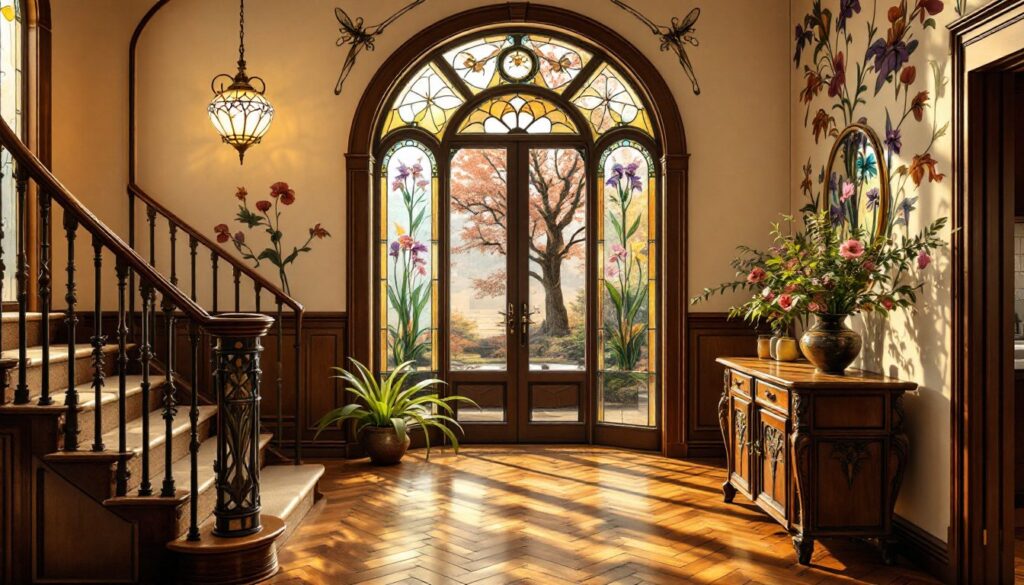
Art Nouveau pulled its decorative vocabulary straight from the natural world: lilies, irises, poppies, dragonflies, peacock feathers, and stylized female figures with flowing hair. These motifs appeared in stained glass windows, hand-painted tile, carved wood panels, and wallpaper.
For modern applications, ceramic tile with botanical relief works well in entryways, bathrooms, and kitchen backsplashes. Look for encaustic or hand-glazed tiles that echo the period’s color palette: deep greens, amber, plum, teal, and ochre. These tiles often run $12–$30 per square foot depending on production method and origin, with European imports on the higher end.
Stenciling is a budget-friendly alternative to custom tilework or murals. Art Nouveau stencil patterns, available through specialty suppliers or easily cut on a vinyl cutter, can be applied to plaster walls, wood wainscoting, or canvas floorcloth using milk paint or chalk-based finishes. Prep is critical: walls must be clean, lightly sanded (220-grit), and primed if the substrate is raw drywall. Use low-tack painter’s tape and a stencil brush with minimal paint to avoid bleed-under.
Original Art Nouveau interiors often featured hand-painted or block-printed wallpaper. Reproduction papers exist, but they’re pricey and installation is unforgiving on anything other than perfectly smooth walls. Consider hiring a paper hanger if the substrate has texture or if seams need to align across complex patterns.
Essential Elements to Create an Art Nouveau Interior
Building an Art Nouveau-inspired interior comes down to a handful of high-impact elements that set the visual tone without requiring a full teardown.
Lighting fixtures are non-negotiable. Art Nouveau championed Tiffany-style leaded glass, opalescent shades, and hand-forged metal bases shaped like stems or vines. Modern reproductions range from mass-market imports to artisan-made pieces. When selecting fixtures, look for asymmetrical shades, organic metalwork, and warm-toned glass in amber, green, or iridescent finishes. Avoid overly bright LEDs: opt for 2700K–3000K bulbs to mimic the warm glow of early incandescent and gas lamps.
Installing a period-style pendant or sconce is straightforward for anyone comfortable with basic electrical work, but all wiring must comply with the National Electrical Code (NEC). If replacing an existing fixture, turn off the breaker, confirm the box is rated for the new fixture’s weight, and use wire nuts rated for the gauge. Heavier pieces may require a pancake box or fan-rated brace. When in doubt, hire a licensed electrician, especially for ceiling fixtures over 50 pounds.
Woodwork and cabinetry in Art Nouveau spaces favor medium to dark hardwoods, mahogany, walnut, oak, often with visible grain and minimal stain to let the natural figure show. Doors and cabinet fronts might include carved floral panels or inset glass with etched or painted designs. Custom cabinetry is expensive, but homeowners can retrofit existing pieces with new doors, adding decorative glass inserts or routing shallow relief patterns with a handheld router and a core box or ogee bit. Always use a edge guide or template for clean, repeatable curves.
Flooring leaned toward parquet, wide-plank hardwood, or encaustic tile. If installing new flooring, consider engineered hardwood in a herringbone or chevron pattern, which nods to the period without the cost and acclimation demands of solid wood. For tile, look for hex, arabesque, or custom patterns in matte glazes. Subfloor prep is crucial: ensure it’s level within 1/8 inch over 10 feet, and use the appropriate underlayment, cement board for tile, cork or foam for engineered wood.
Metalwork, railings, hinges, door handles, fireplace screens, should be wrought iron, brass, or copper with hand-hammered or patinated finishes. Replacement hardware is available from architectural salvage dealers and specialty retailers. Installation is usually a matter of matching screw holes or drilling new pilot holes: use a center punch and go slow with a cobalt or titanium bit if working with hardened steel strike plates.
How to Incorporate Art Nouveau Style in Contemporary Spaces
Blending Art Nouveau into a modern home doesn’t mean replicating a 1905 Parisian salon. The goal is to introduce signature elements, curves, craft, nature motifs, within a clean, functional layout.
Start with one or two statement pieces rather than a room-wide overhaul. An Art Nouveau mirror with a carved wood or cast bronze frame over a fireplace mantel, a leaded-glass transom above a doorway, or a single accent wall with botanical stencil work can anchor the aesthetic without overwhelming the space.
Millwork upgrades offer high visual impact. Replace standard flat-panel interior doors with versions that feature curved top rails or inset glass. Swap builder-grade baseboards and casings for profiles with gentle curves or stepped reveals. A finish carpenter can mill custom trim, or homeowners can order from specialty suppliers who offer period-appropriate profiles in primed MDF ready for paint.
In kitchens and bathrooms, use Art Nouveau tile as a backsplash accent, not a floor-to-ceiling treatment. Pair it with simple subway tile or painted drywall to avoid visual clutter. Choose fixtures, faucets, cabinet pulls, in oil-rubbed bronze or unlacquered brass to introduce the hand-crafted metal aesthetic. Install a vessel sink in a carved wood vanity or add a tile mural behind the range.
Color and finish matter. Art Nouveau interiors favored rich, saturated hues and naturalistic palettes. Consider deep teal, olive green, burgundy, or mustard for accent walls, paired with creamy off-whites and warm wood tones. Use satin or eggshell paint finishes instead of flat or high-gloss to echo the period’s preference for subtle luster. If working with plaster or drywall, a skim coat of joint compound followed by light sanding creates a smoother, more refined surface that takes paint better and reads as more premium.
Textiles, curtains, upholstery, rugs, should incorporate flowing, organic patterns. Look for fabrics with stylized florals, paisley, or damask in jewel tones. Avoid synthetics that read cheap: linen, velvet, and wool blends hold up better and photograph truer to period authenticity.
Finally, respect the home’s existing architecture. Art Nouveau works best in spaces with some vertical volume, tall ceilings, large windows, but it can be adapted to compact or modern floor plans by keeping the intervention light. A vintage light fixture, a single piece of carved furniture, or a stenciled border can suggest the style without forcing it.
Conclusion
Art Nouveau interior design thrives on craft, curve, and a direct line to the natural world, principles that fit just as well in a 2026 renovation as they did in a 1900 townhouse. Homeowners don’t need period-perfect replicas to capture the style’s elegance. Strategic upgrades to millwork, lighting, tile, and hardware, combined with a willingness to embrace organic forms over rigid geometry, can bring timeless Art Nouveau character into contemporary spaces without sacrificing function or budget.